Contiuing my interposed introduction of my OTI work, which began with a new section 1.2 and the first part of section 1.3, here is the the second major subsection within 1.3 of the Introduction.
This part is a bit more... choppy... in that it does not follow OPAR's nice linear structure but goes left-right-left-right stepping fashion, spiralling back here and there as required. This is all to the good - I see for myself why this is required, and besides this is what Dr Peikoff prescribed in lecture 2 in his discussion of the contrast between an OTI hierarchy and and OPAR hierarchy (about half-way through, just before and continued after the technical difficulties he had to recover from in the middle of the lecture).
Remember also that this much is a once-over to get an overview that can be used to guide a more in-depth examination and induction. It is not intended to provide all the real chewing that is required. Again, this is for the OTI-vs-OPAR hierarchy.
Showing posts with label Philosophy. Show all posts
Showing posts with label Philosophy. Show all posts
Friday, December 28, 2012

Sunday, December 23, 2012
OTI post #9
Continuing my interposed beginnings, here is another installment. It is not all of what I have numbered as 1.3, because that section is large and admits of being broken up into separate subsections (as in fact it is).
This extract only grounds the practice of starting in philosophy as babies, by looking at the world, even though we are now many years into life. After that I then begin looking at the three axioms in a bit more detail, give a quick indication of the validity of perception in defending their self-evidency, and so on.
By the way, the two lecture series on The History of Western Philosophy have turned out to be far more useful than I had imagined they would be. I owe quite a lot of my growing understanding to learning from them, especially the part one on the the founders from Thales to Hume. In particular, they ram home how vital the question of Universals is and why getting Objectivist Epistemology into the universities is a necessity if there is to be a future for civilisation. The discussions of Objectivism given at the ends were also valuable, and have heavily influenced what I have written (in some places, I figured out things for myself, then listened to the lectures, and discovered to my delight that I was not in danger of contradicting Objectivism). Together, they also give a far greater context to how and why Dr Peikoff wrote what he did and how he did in OPAR. I strongly recommend you buy the MP3s: link to part one, link to part two.
This extract only grounds the practice of starting in philosophy as babies, by looking at the world, even though we are now many years into life. After that I then begin looking at the three axioms in a bit more detail, give a quick indication of the validity of perception in defending their self-evidency, and so on.
By the way, the two lecture series on The History of Western Philosophy have turned out to be far more useful than I had imagined they would be. I owe quite a lot of my growing understanding to learning from them, especially the part one on the the founders from Thales to Hume. In particular, they ram home how vital the question of Universals is and why getting Objectivist Epistemology into the universities is a necessity if there is to be a future for civilisation. The discussions of Objectivism given at the ends were also valuable, and have heavily influenced what I have written (in some places, I figured out things for myself, then listened to the lectures, and discovered to my delight that I was not in danger of contradicting Objectivism). Together, they also give a far greater context to how and why Dr Peikoff wrote what he did and how he did in OPAR. I strongly recommend you buy the MP3s: link to part one, link to part two.
Saturday, December 15, 2012
OTI post #8
Given the long time since I've done any OTI work, from me always finding unsatisfactory how I began it and my procedures for working, I reviewed what I wrote so far.I didn't like how it simply dove in and started with a context that was taken rather arbitrarily, and had no connection as to why the axioms of Objectivism were indeed the proper places to start. For instance, how I addressed that back then, in post 5, has always struck me as seriously wrong somehow. There was something wrong right from the get-go.
I figured out what it was: a grossly inadquate context and non-use of the spiral theory of knowledge. My old introduction in post 1 had three parts: reasons, two elements of context, and an outline of methodology. I retain the reasons, but I am breaking up the rest, beginning with interposing a sequence on the search for foundations that leads to a basic discussion of the axioms. Then I will give Objectivism up to epistemology a once-over and use that to ground the proper context and methodology for the real chewing to come later.
So far I've done that first interposition, and have started work on the once-over. Here, then, is the first installment of that new work.
I figured out what it was: a grossly inadquate context and non-use of the spiral theory of knowledge. My old introduction in post 1 had three parts: reasons, two elements of context, and an outline of methodology. I retain the reasons, but I am breaking up the rest, beginning with interposing a sequence on the search for foundations that leads to a basic discussion of the axioms. Then I will give Objectivism up to epistemology a once-over and use that to ground the proper context and methodology for the real chewing to come later.
So far I've done that first interposition, and have started work on the once-over. Here, then, is the first installment of that new work.
Thursday, April 28, 2011
A simple connection
Of course *palm-forehead-smack*! I just realised - leftists look at the world of business and think it is a larger version of their tiresomely cliche` view of the schoolyard as seen in movies: brainless jocks at the top of the pecking order hoarding all the resources for their own interests, always bashing down the weaker but smarter kids, teachers/politicians dealing with insufficient funding unless they work in relation to the jocks' interests, etc etc etc. Heck, there's even at least one whiny song I know of explicitly about it - Simple Plan's "High School never ends".
Update: second *palm-forehead-smack*... the Comprachicos. Simple Plan don't know the half of it.
These movies and song etc are of course of the creations of other leftists, working from previous incarnations of the same mentality that set their premisses, and they so experience an echo-chamber that acts as psychological and psychepistemological reinforcement. That's the same lunatic mentality seen when they prattled on about how that the fake military letter about Bush at the heart of Rathergate was something that "bespeaks a truth" or whatever that commentary was even after the fakeness was demonstrated.
Question: is there any connection of the above to the hateful reaction to the Atlas Shrugged movie (which I haven't seen) that is more than just about the sociopolitical content? Specifically, I am wondering if they instinctively realise that the Altas Shrugged movie - however poor it may or may not be as a stand-alone piece of art - could hinder that echo-chamber mechanism at the unspoken psychoepistemological level. I am not in any position to find out, at present. This question must therefore one more thing for others, more immersed in concretes than I, to follow up on if they judge fit.
JJM
Update: second *palm-forehead-smack*... the Comprachicos. Simple Plan don't know the half of it.
These movies and song etc are of course of the creations of other leftists, working from previous incarnations of the same mentality that set their premisses, and they so experience an echo-chamber that acts as psychological and psychepistemological reinforcement. That's the same lunatic mentality seen when they prattled on about how that the fake military letter about Bush at the heart of Rathergate was something that "bespeaks a truth" or whatever that commentary was even after the fakeness was demonstrated.
Question: is there any connection of the above to the hateful reaction to the Atlas Shrugged movie (which I haven't seen) that is more than just about the sociopolitical content? Specifically, I am wondering if they instinctively realise that the Altas Shrugged movie - however poor it may or may not be as a stand-alone piece of art - could hinder that echo-chamber mechanism at the unspoken psychoepistemological level. I am not in any position to find out, at present. This question must therefore one more thing for others, more immersed in concretes than I, to follow up on if they judge fit.
JJM
Monday, April 25, 2011
Lest We Forget
Today, 25th April, it is ANZAC Day.
The day was initially instituted to remember those who died in the Gallipoli campaign, which was a horrendous affair marked also by great heroism on both sides. It has since grown to remember all the theatres in which Australian and New Zealander solders have fallen, to reflect on the cost of war and what it takes to defend our freedoms.
The word "sacrifice" is mentioned a lot. It is times like these one really feels the loss of not having a good solid and active verb for being willing to bear immense costs in order to secure and promote something of even greater value. When the servicemen and women mention this word the honest listener knows what they mean, and approve of that meaning and its spirit. And on the day, that's what is important - the battle for epistemology can be put aside until tomorrow.
In the meantime, this day is not over. I have not personally lost anyone in war, and I will not be a mere recreational griever cheapening the pain of those who have. But I do say this: for those who fell so that I may remain free, I am forever grateful, and to the men and women in still living and armed service, who have taken an oath such that I may sleep safely tonight,
thank you.
JJM
The day was initially instituted to remember those who died in the Gallipoli campaign, which was a horrendous affair marked also by great heroism on both sides. It has since grown to remember all the theatres in which Australian and New Zealander solders have fallen, to reflect on the cost of war and what it takes to defend our freedoms.
The word "sacrifice" is mentioned a lot. It is times like these one really feels the loss of not having a good solid and active verb for being willing to bear immense costs in order to secure and promote something of even greater value. When the servicemen and women mention this word the honest listener knows what they mean, and approve of that meaning and its spirit. And on the day, that's what is important - the battle for epistemology can be put aside until tomorrow.
In the meantime, this day is not over. I have not personally lost anyone in war, and I will not be a mere recreational griever cheapening the pain of those who have. But I do say this: for those who fell so that I may remain free, I am forever grateful, and to the men and women in still living and armed service, who have taken an oath such that I may sleep safely tonight,
thank you.
JJM
Sunday, March 20, 2011
OTI post #3 - Consciousness is conscious
I'd previously started with material on context and method, and figured out how to arrive at existence exists from observation. Now to move on to consciousness. Again, this is probably longer than it needs to be, but it's done.
Saturday, March 19, 2011
God as government
This is fascinating - and telling... The cynical idea that religion and socialism are the only two alternatives.
The fact is that one cannot establish a philosophic positive by demolishing a negative. Commentary like this shows that atheism alone is nowhere near enough to establish liberty - without reason and egoism being proudly promoted as essential parts of the secularisation of society the sense-of-life of religion - not to mention the false alternative of dogmatism versus skepticism - will continue to poison the ethical and political codes even even alleged athiests, and the consequences of the spectacle itself gives fuel back to the religious cause.
The real enemy of man has always been religion, not socialism, for the latter feeds on the former and cannot survive long without its lasting influence. Religion must be despatched from this world - but the method of despatching it can only be by putting the greatness of "Reality, Reason, and Rights" in its place.
JJM
The fact is that one cannot establish a philosophic positive by demolishing a negative. Commentary like this shows that atheism alone is nowhere near enough to establish liberty - without reason and egoism being proudly promoted as essential parts of the secularisation of society the sense-of-life of religion - not to mention the false alternative of dogmatism versus skepticism - will continue to poison the ethical and political codes even even alleged athiests, and the consequences of the spectacle itself gives fuel back to the religious cause.
The real enemy of man has always been religion, not socialism, for the latter feeds on the former and cannot survive long without its lasting influence. Religion must be despatched from this world - but the method of despatching it can only be by putting the greatness of "Reality, Reason, and Rights" in its place.
JJM
Monday, March 14, 2011
OTI post #2 - Existence exists
In post #1 I began with a basic introduction and the context for the work. This is where I begin the actual work itself. I started my OTI work at "Chapter one" (of course!), but it is also within "Part One." Part one is all of metaphysics of relevance to me, with chapter one focussing specifically on the three axioms. I can't and wont commit to a set schedule of posting, though.
Chapter 1 has 5 sections so far (I've completed 4): intro, existence exists, consciousness is consciousness, a thing is itself, and these three as axioms. This post here contains the first two sections.
Chapter 1 has 5 sections so far (I've completed 4): intro, existence exists, consciousness is consciousness, a thing is itself, and these three as axioms. This post here contains the first two sections.
Sunday, March 13, 2011
OTI post #1
This is the inaugural post of my work on redoing my understanding of Objectivism, through induction, following on from my conclusions and resulution in January. The quantity of writing is probably overkill, at least early on, so be warned if you continue on. When I am satisfied with philosophy, at least in epistemology and ethics, sufficient to ground value theory, I will then tackle economics and economic method again.
The 'prerequisites' of this are: Understanding Objectivism, Objectivism Through Induction, The Logical Leap, OPAR, ITOE, and The Art of Thinking. Knowledge of logic wouldn't go astray either, but I will be investigating that directly for myself in time, too.
To start with, this is what I wrote as my own introduction.
The 'prerequisites' of this are: Understanding Objectivism, Objectivism Through Induction, The Logical Leap, OPAR, ITOE, and The Art of Thinking. Knowledge of logic wouldn't go astray either, but I will be investigating that directly for myself in time, too.
To start with, this is what I wrote as my own introduction.
Thursday, February 24, 2011
A question and a dare
A question for various segments of alleged atheists (they know who they are):
If you consider yourself truly to be atheist, why do speak and act as though emotions were some magical connection to an infallible source of truth and goodness that reason is impudent if it dares question?
Don't say I am not looking at you: all those who posit subjectivism - of either the individual or social variety - are as guilty as sin in this regard.
Emotions are essential for human life, without which life is neither worth living nor even capable of being lived. But emotions are not tools of cognition - they are not means by which one can determine "this is true" and "this is good". So, certainly, they have pride of place in human life - but cognition is not that place.
Here's the dare:
Find out how emotions arise. Then go find a standard of value without committing that sin in any shape or manner. And, once you've done that, question every value judgement you've ever made.
JJM
If you consider yourself truly to be atheist, why do speak and act as though emotions were some magical connection to an infallible source of truth and goodness that reason is impudent if it dares question?
Don't say I am not looking at you: all those who posit subjectivism - of either the individual or social variety - are as guilty as sin in this regard.
Emotions are essential for human life, without which life is neither worth living nor even capable of being lived. But emotions are not tools of cognition - they are not means by which one can determine "this is true" and "this is good". So, certainly, they have pride of place in human life - but cognition is not that place.
Here's the dare:
Find out how emotions arise. Then go find a standard of value without committing that sin in any shape or manner. And, once you've done that, question every value judgement you've ever made.
JJM
Sunday, February 20, 2011
Category theory
Four years of engineering mathematics and we were never introduced to this. Whether or not it was used in formulating electrical engineering methodologies such as symmetrical components, however, is another matter. We never got into that kind of underlying theory, we just learned how to use various techniques to solve real-world problems.
JJM
JJM
Quick note on sim.eq's and econ method
I realised this morning that, unless I expressly say otherwise, someone is going to think I am setting up a lead-in to Walrasian equations for solving economic problems. So let me now expressly say that I intend no such thing, and that I would view an attempt of that nature as inane (and that's being charitable).
The application of the analogy of simultaneous equations to economics lies in the issues of concepts and principles. That is, complex phenomena can only be understood by first understanding the individual elements and lesser principles, which is conceptually akin to using the solutions found to simpler equations as means to solving the more complex equations. This is as far as it goes, albeit good enough to begin hammering stakes into the hearts of both empiricism and rationalism.
By the way, I reject the complaint about a lack of experimental ability in the humanities, leading to an alleged justification of pure rationalism in these fields, just the same way as we can reject the same approach is rejectable in astrophysics. It is not as though since we can't experiment by making up new planets and putting them in a variety of orbits that we can't be sure of the laws of planetary motion, or that this justifies some sort of attempt at arriving them through pure mathematical deduction divorced almost entirely from direct observation, is it? I do not have any respect for the Austrians' special-pleading for pure rationalism in economic theory. I am quite sure that Newton, Kepler, Galileo, Copernicus, and a host of other figures who, through observation and inference from those observations, began to piece together the picture of how the solar system worked, would have some stern words to say to Austrians if they (the astronomers) heard the Austrians go on and on about the lack of experimental ability.
JJM
The application of the analogy of simultaneous equations to economics lies in the issues of concepts and principles. That is, complex phenomena can only be understood by first understanding the individual elements and lesser principles, which is conceptually akin to using the solutions found to simpler equations as means to solving the more complex equations. This is as far as it goes, albeit good enough to begin hammering stakes into the hearts of both empiricism and rationalism.
By the way, I reject the complaint about a lack of experimental ability in the humanities, leading to an alleged justification of pure rationalism in these fields, just the same way as we can reject the same approach is rejectable in astrophysics. It is not as though since we can't experiment by making up new planets and putting them in a variety of orbits that we can't be sure of the laws of planetary motion, or that this justifies some sort of attempt at arriving them through pure mathematical deduction divorced almost entirely from direct observation, is it? I do not have any respect for the Austrians' special-pleading for pure rationalism in economic theory. I am quite sure that Newton, Kepler, Galileo, Copernicus, and a host of other figures who, through observation and inference from those observations, began to piece together the picture of how the solar system worked, would have some stern words to say to Austrians if they (the astronomers) heard the Austrians go on and on about the lack of experimental ability.
JJM
Saturday, February 19, 2011
Simultaneous concretisation
During this revision of induction I had the intention of starting from scratch, given how fundamental the topic is and that I recognise my past methodology was highly questionable. I now attribute that, in part at least, to taking to Mill too enthusiastically. I now recall that it was from his "A System of Logic" that I got the idea, rightly criticised by Dr Peikoff, of treating induction as indicative and that a conclusion was settled when one could tie it back to something broader from which the initial induction could now be deduced. His methods, as elements, are fine, but that later wrap up method is way off. For that reason I have determined that I really ought start from scratch, paying very close attention to method.
Still, my post on the analogy to solving simultaneous equations did prompt me to try to find my old writings from back when I was first trying to digest Objectivism, not just the material on that ABC stuff but everything I wrote just to see how badly I did go wrong (I knew I did, so I didn't go looking for it before). Almost all of it is gone, though, both on my computer and physically. All I have seem to have left from back then (the general late 90's period) are three of those diagrams (the date-stamp says it is actually circa 1998, not 1996 as I had thought), some other trivial writings, my notes from Understanding Objectivism, and notes from other courses such as Objective Communication. To be honest, I am not all that fussed about this precisely because I now recognise that my own thoughts were deeply flawed, and because today the only things I would find valid is precisely what does still exist: those UO and OC notes. I do recall dumping some stuff for that very reason, but perhaps I was more thorough about doing so than I actually recall being. I do know there was a hard-drive crash involved, as well. *shrug*
Still, my post on the analogy to solving simultaneous equations did prompt me to try to find my old writings from back when I was first trying to digest Objectivism, not just the material on that ABC stuff but everything I wrote just to see how badly I did go wrong (I knew I did, so I didn't go looking for it before). Almost all of it is gone, though, both on my computer and physically. All I have seem to have left from back then (the general late 90's period) are three of those diagrams (the date-stamp says it is actually circa 1998, not 1996 as I had thought), some other trivial writings, my notes from Understanding Objectivism, and notes from other courses such as Objective Communication. To be honest, I am not all that fussed about this precisely because I now recognise that my own thoughts were deeply flawed, and because today the only things I would find valid is precisely what does still exist: those UO and OC notes. I do recall dumping some stuff for that very reason, but perhaps I was more thorough about doing so than I actually recall being. I do know there was a hard-drive crash involved, as well. *shrug*
Thursday, February 17, 2011
Simultaneous equations and induction
(Update for direct-hitters to this post: concretisation is here.)
A long time ago (circa 1996) I thought up an analogy in reasoning to the mathematical methodology of simultaneous equations. I eventually dropped it, however, because I thought it was too rationalistic (plus because I was being ridiculed for it - though somewhat deservedly at the time, too, I must add). I now realise that I was definitely on to something important back then and that I was wrong to drop it entirely.
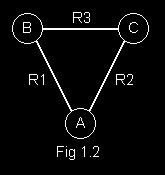
What I had in mind back then was quite simple: if one knew the relationship between A and B, and one knew the relationship between A and C, where for instance A was oneself (ie one's consciousness), then one could identify the relationship between B and C as it stood independently of A (ie, contra Kant, conceptually able to identify things in themselves). Working on that principle, one can then tackle more and more complex relationships, succesively busting down complex equations into lesser ones and from there to the identification of individual variables. I had neat diagrams to go with it, too, such as:
The reason why I think that there is something valid in this for all thought in general (I've never rejected the fact that it was a definitely valid method of approaching the quantitative aspects of reality) is because of its connection to Mill's methods (particularly difference and agreement) and their connection in turn to the general cognitive processes of differentiation and integation. It is quite valid to view systematic methodologies for solving them, such as Gaussian Elimination, as being advanced implementations of Mill's methods to the mathematical realm. That is, what is GE but a complex method for the progressive discovery of residues? Taking it back to reality itself, what is the method of concomitant variations but the means of identifying the equations themselves? There's even analytical software available for that purpose - that is what all those statistical packages amount to, with the R-squared variables and the like indicating how much confidence one can place in the equations so generated from a mass of raw input data.
The other reason why I am reversing my past dropping is that Miss Rand noted that to invalidate concept formation one first had to invalidate algebra. The solving of simultaneous equations is an element of the subject of algebra! It is one of the methods that is directly applicable to reality itself. The fact that there really is a strong mathematical element to consciousness, along with that express identification, clearly suggests to me that the method of solving simultaneous equations ought be investigated by the epistemologist. But I am neither a professional mathematician nor a professional philosopher, so I will leave this for those professional epistemologists to develop.
That being said, I know what I know, I do know that I am on to something valid and that it is not to be dismissed as inherently rationalistic. "Everything in reality is simultaneous" notes Dr Peikoff in many places, and that hierarchy in epistemology existed because we had to approach reality in that fashion: knowledge is built on previous knowledge. I strongly suspect that this is also a tie-in with the spiral theory of knowledge, in particular applications, in that the more one knows the more one can go back and refine more detail out of equations that one had already partly solved in the past. Thus I will use it when and how I think appropriate, being careful of course not to get over-enthusiastic and rationalist about it.
Dr Peikoff also notes that science was nothing more than the conceptual unravelling of perceptual data. Miss Rand noted that cognition was a mathematical process. I would suggest, then, in combining the two along with recognition of Mill's methods and their derivatives (particularly in mathematics), is that science in large part consists of identifying the figurative or literal equations in reality or fragments thereof and also of contrasting various equations against each other to isolate ever smaller valid sub-equations and ultimately to identify the root irreducible variables.
JJM
A long time ago (circa 1996) I thought up an analogy in reasoning to the mathematical methodology of simultaneous equations. I eventually dropped it, however, because I thought it was too rationalistic (plus because I was being ridiculed for it - though somewhat deservedly at the time, too, I must add). I now realise that I was definitely on to something important back then and that I was wrong to drop it entirely.
What I had in mind back then was quite simple: if one knew the relationship between A and B, and one knew the relationship between A and C, where for instance A was oneself (ie one's consciousness), then one could identify the relationship between B and C as it stood independently of A (ie, contra Kant, conceptually able to identify things in themselves). Working on that principle, one can then tackle more and more complex relationships, succesively busting down complex equations into lesser ones and from there to the identification of individual variables. I had neat diagrams to go with it, too, such as:
The reason why I think that there is something valid in this for all thought in general (I've never rejected the fact that it was a definitely valid method of approaching the quantitative aspects of reality) is because of its connection to Mill's methods (particularly difference and agreement) and their connection in turn to the general cognitive processes of differentiation and integation. It is quite valid to view systematic methodologies for solving them, such as Gaussian Elimination, as being advanced implementations of Mill's methods to the mathematical realm. That is, what is GE but a complex method for the progressive discovery of residues? Taking it back to reality itself, what is the method of concomitant variations but the means of identifying the equations themselves? There's even analytical software available for that purpose - that is what all those statistical packages amount to, with the R-squared variables and the like indicating how much confidence one can place in the equations so generated from a mass of raw input data.
The other reason why I am reversing my past dropping is that Miss Rand noted that to invalidate concept formation one first had to invalidate algebra. The solving of simultaneous equations is an element of the subject of algebra! It is one of the methods that is directly applicable to reality itself. The fact that there really is a strong mathematical element to consciousness, along with that express identification, clearly suggests to me that the method of solving simultaneous equations ought be investigated by the epistemologist. But I am neither a professional mathematician nor a professional philosopher, so I will leave this for those professional epistemologists to develop.
That being said, I know what I know, I do know that I am on to something valid and that it is not to be dismissed as inherently rationalistic. "Everything in reality is simultaneous" notes Dr Peikoff in many places, and that hierarchy in epistemology existed because we had to approach reality in that fashion: knowledge is built on previous knowledge. I strongly suspect that this is also a tie-in with the spiral theory of knowledge, in particular applications, in that the more one knows the more one can go back and refine more detail out of equations that one had already partly solved in the past. Thus I will use it when and how I think appropriate, being careful of course not to get over-enthusiastic and rationalist about it.
Dr Peikoff also notes that science was nothing more than the conceptual unravelling of perceptual data. Miss Rand noted that cognition was a mathematical process. I would suggest, then, in combining the two along with recognition of Mill's methods and their derivatives (particularly in mathematics), is that science in large part consists of identifying the figurative or literal equations in reality or fragments thereof and also of contrasting various equations against each other to isolate ever smaller valid sub-equations and ultimately to identify the root irreducible variables.
JJM
Monday, January 17, 2011
Methodological flaw?
Some explanations are in order. One of the things I have been doing over the last several weeks is listening to the "Induction in Physics and Philosophy" and the "Objectivism Through Induction" recorded lectures. I bought them at OCON08 but totally forgot about them until recently, and I still haven't finished OTI (I'm currently on lecture 5). They are proving to be extremely valuable... and also making me question the extent to which I have gone wrong in what I thought was proper inductive validation by oneself of another's findings.
Of present concern is how I had tackled economics, which I began questioning when I wondered if I had been wrong to some degree in the method. What I had been doing, at least to some extent, was effectively Aristotle's induction-as-suggestion method.
For this I had gathered a host of examples, both those themselves mentioned elsewhere (Merton's original paper and Wikipedia, mostly), examples I recall from others' specific instances, and those of my own observation and experience, and then treated them as the data for a preliminary induction. The next step I took was to examine the causes (and I have come to the conclusion that there are but two direct causes and that the other causes of the phenomena are in fact causes of those first two causes), and so tie the phenomenon to various facts (the complexity of existence, human capacities for focus and evasion/pretence, other facets of volitional consciousness, and so on). Finally, I then sought to reduce all the critical concepts back to direct perception. It is the second step there - the tieing in with other facts - that I am finding is problematic in what I have done.
I am glad I caught this at an early stage rather than waste a large amount of time only to find out the fact of such wastage at a later date. I'd hate to be in a similar position to a researcher that von Mises wrote about, who spent - and thus wasted - almost his entire academic life in systematically calculating the elasticities of every significant commodity that people regularly consumed. Yet, for what I have done so far, I am not sure that I have done exactly what Dr Peikoff said was wrong. I was not avowedly looking for broader principles to deduce the law from... but until I spend time going over my work from scratch a second time and working to fully comprehend the lessons of OTI it may well be that I had been unwittingly making that mistake anyway, so don't expect further publication from me in the immediate future.
By the way, over the last week of December I realised that I - and evidently a great number of others - had been making a subtle mistake. There is a definite distinction between that which was unintended and that which was unanticipated, and the law applies to the latter, not the former. This was both Merton's original description, and also cross-ties better with all the implications that are in fact inferred from the law by most and all those that should be so inferred. But more on that when I do finish writing.
JJM
Of present concern is how I had tackled economics, which I began questioning when I wondered if I had been wrong to some degree in the method. What I had been doing, at least to some extent, was effectively Aristotle's induction-as-suggestion method.
For this I had gathered a host of examples, both those themselves mentioned elsewhere (Merton's original paper and Wikipedia, mostly), examples I recall from others' specific instances, and those of my own observation and experience, and then treated them as the data for a preliminary induction. The next step I took was to examine the causes (and I have come to the conclusion that there are but two direct causes and that the other causes of the phenomena are in fact causes of those first two causes), and so tie the phenomenon to various facts (the complexity of existence, human capacities for focus and evasion/pretence, other facets of volitional consciousness, and so on). Finally, I then sought to reduce all the critical concepts back to direct perception. It is the second step there - the tieing in with other facts - that I am finding is problematic in what I have done.
I am glad I caught this at an early stage rather than waste a large amount of time only to find out the fact of such wastage at a later date. I'd hate to be in a similar position to a researcher that von Mises wrote about, who spent - and thus wasted - almost his entire academic life in systematically calculating the elasticities of every significant commodity that people regularly consumed. Yet, for what I have done so far, I am not sure that I have done exactly what Dr Peikoff said was wrong. I was not avowedly looking for broader principles to deduce the law from... but until I spend time going over my work from scratch a second time and working to fully comprehend the lessons of OTI it may well be that I had been unwittingly making that mistake anyway, so don't expect further publication from me in the immediate future.
By the way, over the last week of December I realised that I - and evidently a great number of others - had been making a subtle mistake. There is a definite distinction between that which was unintended and that which was unanticipated, and the law applies to the latter, not the former. This was both Merton's original description, and also cross-ties better with all the implications that are in fact inferred from the law by most and all those that should be so inferred. But more on that when I do finish writing.
JJM
Sunday, September 26, 2010
Modern Science Map
Crispian Jago's Modern Science Map (original post). I can't vouch for its accuracy (treat it as you would the content of a Wikipedia entry, since it contains links thereto), but the concept and execution is awesome!
JJM
JJM
Sunday, September 19, 2010
New Q&A site
A new Objectivist Question & Answer site is up and running. Looks interesting, but to be really valuable there would have to be people involved who remember to keep answers on both a principles and concrete level, lest it become a mere source of out-of-context casuistry.
For those who want to promote it more on their own websites or blogs, the FAQ page has HTML code for your templates.
Edit: it is moderated by Greg Perkins, and so far the main answerers are doing both. Good. I've made my first contributions for this question and this question, awaiting Greg's approval.
JJM
For those who want to promote it more on their own websites or blogs, the FAQ page has HTML code for your templates.
Edit: it is moderated by Greg Perkins, and so far the main answerers are doing both. Good. I've made my first contributions for this question and this question, awaiting Greg's approval.
JJM
Monday, September 13, 2010
Response to anarchism: answer 2
To reiterate, the answer to the first question was that a man had a right to intervene unilaterally in others’ disputes existed when those others were using or were about to use force because the principles being used or set up by those others had a clear implication for that first man. It is in his interests to see to it, in at least some form and with major caveats, that principles and precedents in the use of force that are too much at variance with reason do not get a foothold within the minds of other men who are frequently in proximity to him (usually meaning those in his society), because those bad principles and precedents could be used against him. What else they do, outside their use of force, is not his concern, but when they are using force it becomes very much his concern.
The second question was how such a right lead to justifying a single government that rightfully had the monopoly on the non-emergency use of force. Again, I am presuming that most people recognise their moral obligations to act rationally and live according to principle, whose application to the use of force is the basis for that right and is the main part of the caveats surrounding its implementation.
The second question was how such a right lead to justifying a single government that rightfully had the monopoly on the non-emergency use of force. Again, I am presuming that most people recognise their moral obligations to act rationally and live according to principle, whose application to the use of force is the basis for that right and is the main part of the caveats surrounding its implementation.
Wednesday, September 8, 2010
Response to anarchism: answer 1
Here’s the answer I came up with to the first question I left you with before. I will get to the second one tomorrow or Friday (but if not by Friday it will be on Sunday or Monday because I am taking a weekender that includes a joy-flight over Lake Eyre - I'll bring back lots of photos).
That first question was, how does one demonstrate some sort of right to intervene in others’ disputes at no disputants’ request and demand that they settle the disputes reasonably? Steve had this mostly right. The right comes from that the establishment or cementing of various principles of action in others’ minds may be identifiable as a causative factor in a future threat to one’s own interests, where those principles must include reference to use of force because this inclusion then generates the potential of being made subject to those principles and therefore justifies some sort of response through invoking the right to self-defence.
In regards to criminal action, unreasonable behaviour during the hearing of the dispute itself clearly indicates that someone is apt to be unreasonable in their general exercise of their right to use force in self-defence, but there is more than that to consider and the principle at issue covers all stages of the justice process. In the detection of crimes, how an aggrieved or representative thereof gathers evidence or other information is implicitly establishing principles of this and which may be applied in the future to me, not just by that aggrieved but by others following his cue. For example, when there is sufficient evidence for strong suspicion but not belief for guilt beyond reasonable doubt there are grounds for further evidence-gathering activities that would ordinarily be a breach of rights. Whoever invokes this against another is making it clear that they presume authority to invoke it against me, so I am justified in responding with force to ensure the establishment of the principle of using reason in its invocation even though I have no concrete interest in any particular matter at the time. Similarly, in sentencing of the guilty, an excessive sentence is itself a violation of the guilty party’s rights and, by implication, a threat to my own rights in the event I am guilty of something, while an inadequate sentence insufficiently discourages any others to commit crimes and which again puts me in the firing line. And so on.
The application of the right is broader than just criminal action, and covers civil action as well. A civil dispute ought to be settled privately if it can be, where ordinarily outside parties don’t have the right to intervene (hence to that extent Steve was partly right). However, if the dispute goes far enough such that each party is beginning to think of invoking its right to self-defence to defend what each believes is his entitlements, then again principles regarding the use of force are being put into play and give an opening for others to intervene, even without either party calling for such intervention. As with criminal cases, it is not just the resolution alone that is at issue, but also that one’s interest in the principles of the use of force includes interim measures prior to final resolution. For instance, if there is sufficient evidence for it someone may be justified in demanding that someone pause acting for a while until some investigation of potential for non-criminal but rights-violating action is undertaken, such as the question of whether a miner’s blasting is improperly destabilising someone else’s property above. That then leads a right to seek injunctions and other court orders, which are examples of remedies I mentioned in comments earlier. I am justified in taking an active interest in how such a right is invoked and using force myself in response to ensure that it is invoked reasonably.
In these examples and others like them, plus others still I could discuss, it is most definitely in my interests that the course of justice actually follows the virtue of justice and all the other virtues as appropriate. Moreover, because the security of rights in principle are at stake, the principles regarding the use of force are being invoked where it is clearly implied that I may be made subject to them in future, I in turn am justified in invoking my right to self-defence to ensure that reason and justice prevail not just in concrete but as principles that people are expected to adhere to. To deny there being any right to intervene in disputes is to deny the existence of principles and to eviscerate the right of self-defence. But the in-principle existence of such a right does not translate to carte-blanche right to action even if one were dedicated to being reasonable in acting, so the obvious next questions are of when do I have sufficient grounds for this and how am I entitled to act when I do have grounds. We’ll come back to that later because it is part of the answer to the second question.
JJM
That first question was, how does one demonstrate some sort of right to intervene in others’ disputes at no disputants’ request and demand that they settle the disputes reasonably? Steve had this mostly right. The right comes from that the establishment or cementing of various principles of action in others’ minds may be identifiable as a causative factor in a future threat to one’s own interests, where those principles must include reference to use of force because this inclusion then generates the potential of being made subject to those principles and therefore justifies some sort of response through invoking the right to self-defence.
In regards to criminal action, unreasonable behaviour during the hearing of the dispute itself clearly indicates that someone is apt to be unreasonable in their general exercise of their right to use force in self-defence, but there is more than that to consider and the principle at issue covers all stages of the justice process. In the detection of crimes, how an aggrieved or representative thereof gathers evidence or other information is implicitly establishing principles of this and which may be applied in the future to me, not just by that aggrieved but by others following his cue. For example, when there is sufficient evidence for strong suspicion but not belief for guilt beyond reasonable doubt there are grounds for further evidence-gathering activities that would ordinarily be a breach of rights. Whoever invokes this against another is making it clear that they presume authority to invoke it against me, so I am justified in responding with force to ensure the establishment of the principle of using reason in its invocation even though I have no concrete interest in any particular matter at the time. Similarly, in sentencing of the guilty, an excessive sentence is itself a violation of the guilty party’s rights and, by implication, a threat to my own rights in the event I am guilty of something, while an inadequate sentence insufficiently discourages any others to commit crimes and which again puts me in the firing line. And so on.
The application of the right is broader than just criminal action, and covers civil action as well. A civil dispute ought to be settled privately if it can be, where ordinarily outside parties don’t have the right to intervene (hence to that extent Steve was partly right). However, if the dispute goes far enough such that each party is beginning to think of invoking its right to self-defence to defend what each believes is his entitlements, then again principles regarding the use of force are being put into play and give an opening for others to intervene, even without either party calling for such intervention. As with criminal cases, it is not just the resolution alone that is at issue, but also that one’s interest in the principles of the use of force includes interim measures prior to final resolution. For instance, if there is sufficient evidence for it someone may be justified in demanding that someone pause acting for a while until some investigation of potential for non-criminal but rights-violating action is undertaken, such as the question of whether a miner’s blasting is improperly destabilising someone else’s property above. That then leads a right to seek injunctions and other court orders, which are examples of remedies I mentioned in comments earlier. I am justified in taking an active interest in how such a right is invoked and using force myself in response to ensure that it is invoked reasonably.
In these examples and others like them, plus others still I could discuss, it is most definitely in my interests that the course of justice actually follows the virtue of justice and all the other virtues as appropriate. Moreover, because the security of rights in principle are at stake, the principles regarding the use of force are being invoked where it is clearly implied that I may be made subject to them in future, I in turn am justified in invoking my right to self-defence to ensure that reason and justice prevail not just in concrete but as principles that people are expected to adhere to. To deny there being any right to intervene in disputes is to deny the existence of principles and to eviscerate the right of self-defence. But the in-principle existence of such a right does not translate to carte-blanche right to action even if one were dedicated to being reasonable in acting, so the obvious next questions are of when do I have sufficient grounds for this and how am I entitled to act when I do have grounds. We’ll come back to that later because it is part of the answer to the second question.
JJM
Subscribe to:
Posts (Atom)


